

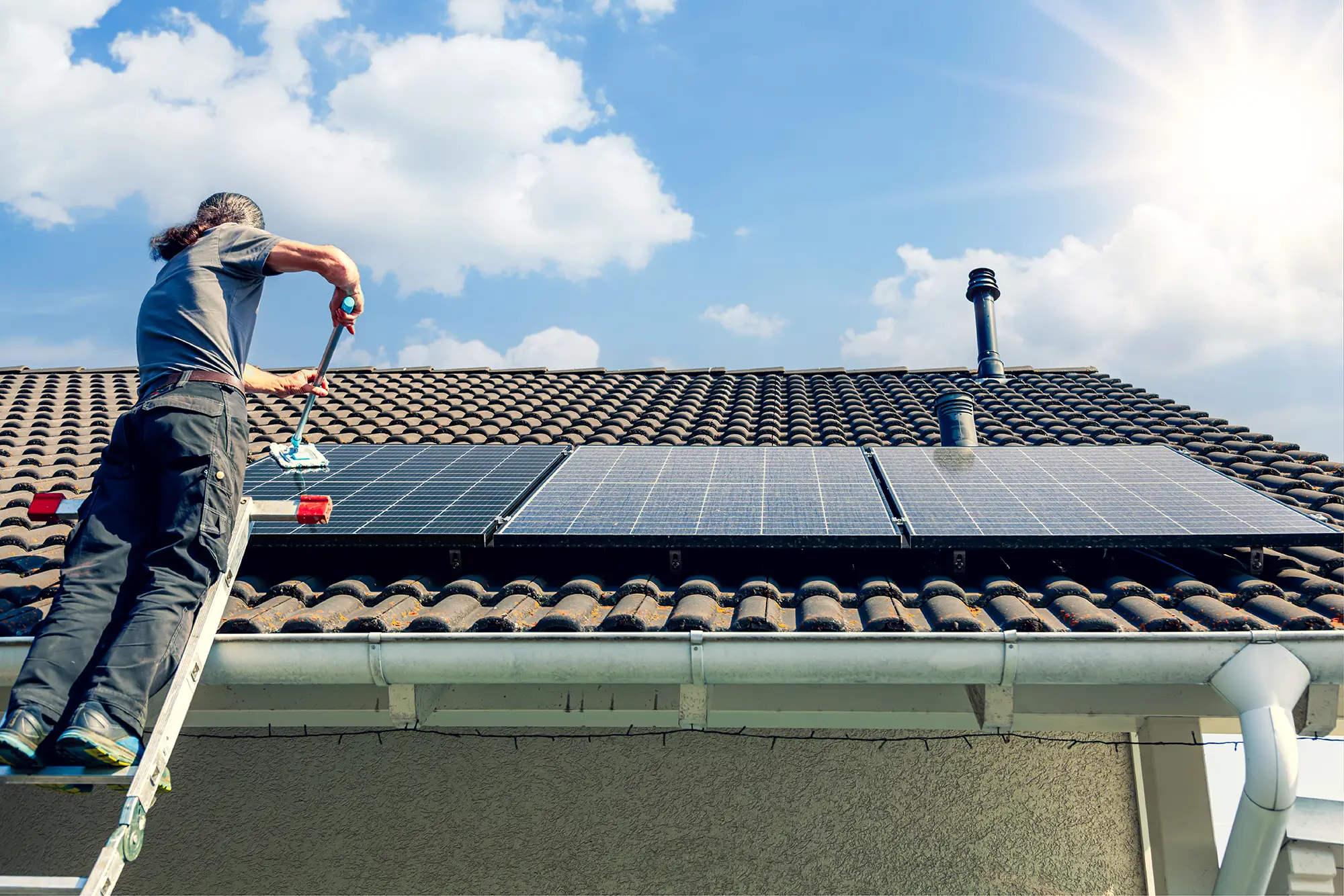
Choosing to upgrade your home with solar is a big step, and it’s normal to wonder what looking after your panels will involve once they’re up on the roof. One of the questions we hear most often is: “Do solar panels need cleaning?”
The good news is that solar panels are usually very easy to look after. They’re not completely maintenance-free, but they don’t need much hands-on care – and in most UK homes, the rain does most of the cleaning for you.
Our guide explains when solar panels need cleaning, how to check them safely, and what other basic maintenance helps keep your system working well for years – so let’s break it down.
The short answer: Do solar panels actually need cleaning?
Yes, but usually not very often.
Rooftop solar panels are mostly always fitted at an angle, so rain can wash away loose dust and dirt. In the UK, regular rainfall helps a lot, meaning that many homeowners rarely need to clean their panels by hand.
Still, some build-up can stay on the glass and block daylight – and when that happens, your system may produce less electricity. Common causes can include:
Bird droppings: One of the most common problems – bird droppings can stick to the panel and may not wash off completely in the rain.
Dust and debris: Homes near busy roads, farms, or building sites may see more dust settling on the roof.
Pollen and tree sap: Pollen can leave a sticky layer on the panels throughout the spring, with trees also dropping sap, leaves, and other debris that block daylight.
Salt spray and coastal grime: If you live near the coast, salty air can leave a cloudy film on the panel glass.
Moss and lichen: These can build up around the edges of panels or mounting points, especially on damp or shaded roofs.
A light layer of dirt may only have a small effect on your renewable energy generation. But heavy build-up can have a bigger impact, especially if it blocks parts of the panel for a long period of time.
How can you tell when your solar panels need cleaning?
You do not need to clean your panels on a fixed schedule, and it’s usually better to check them every now and then and only clean them when it’s actually needed.
A visual inspection
Start from the ground. Pick a spot where you can see the panels clearly – on a bright day, they should look dark and fairly even across the surface.
If you can see large bird droppings, heavy dust, sticky marks, or built-up leaves that stay there for weeks, a clean may help. If the panels just look slightly dusty, it is often best to leave them and let the next spell of rain do the work.
Checking your solar app
Your monitoring app is often the best way to spot a problem. Most home solar systems come with an app that shows how much electricity your panels are generating. If your output drops more than you would expect during a run of similar weather, dirt may be one reason. For example, if generation is much lower on a bright day than it was on a similar bright day recently, it may be worth checking the panels.
Keep in mind that solar output changes with the seasons, daylight hours, and weather. You are looking for an unusual drop, not normal winter variation.
Do solar panels need cleaning during the winter?
Usually less, not more. Winter in the UK often brings more rain and wind, which can help clean panels naturally without you having to touch them. But, that doesn’t mean they’ll be completely left undisturbed.
The impact of the low winter sun
During the winter, the sun sits a lot lower in the sky. That means build-up near the lower edge of the panel can block more light than it would in summer, meaning fallen leaves, moss, or grime may matter more at this time of year.
What should you do when snow covers solar panels?
If snow covers your panels, the safest advice is to simply leave them alone.
A thick layer of snow will stop generation for a while, but climbing onto a roof in icy weather is dangerous. In most cases, the snow will clear on its own. Panels are smooth, dark, and tilted, so once the snow starts to melt, it often slides off – so losing a little generation for a short time is usually a fair trade for staying safe.
Thermal shock
If you do clean panels during very cold weather, be careful with water temperature. Pouring warm water onto very cold glass can cause thermal shock, which may crack the panel – similar to if you were to defrost your car’s windscreen with hot water from the kettle.
If you need to remove a mark, use water that is close to the outside temperature. Never use hot water to melt snow or frost off solar panels.
How to clean solar panels yourself safely?
If your panels are easy to reach from the ground, you may be able to clean them yourself. This could apply to a low garage, extension, or outbuilding.
However, if you can’t clean the panels from the ground, do not do it yourself. Working on ladders or roofs is risky, and it’s easy to damage the panels, wiring or roof tiles by accident. Instead, it’s best to use a professional solar panel cleaner who has the right equipment and insurance to do the job safely – so we’ll go into detail on when you should hire a professional cleaner later in this blog.
If you are able to clean your panels yourself, here’s some things to factor in before you do.
The right equipment for the job
Solar panels need gentle cleaning, so using the wrong tools can damage the glass or the special coating on the surface. Here’s what can help you:
- A soft-bristle brush: This helps lift dirt without scratching the glass.
- An extendable pole: This lets you reach the panels while keeping your feet on the ground.
- Deionised water: This dries more cleanly than tap water, which can leave mineral marks behind.
- A squeegee: Useful for removing excess water and reducing streaks.
What you mustn’t use to clean your panels
Some tools and products can damage your panels or affect your warranty, so we advise you stay clear of the below to keep your panels as good as new for longer.
- Pressure washers: These can force water into seals and damage parts of the system.
- Abrasive sponges: Anything rough can scratch the glass.
- Harsh chemicals: Avoid bleach, strong detergents, and standard window sprays. If water alone is not enough, only use a very mild product that is suitable for solar panels.
Step-by-step DIY cleaning process
- Choose the right time: Clean early in the morning or on a light evening on a mild day, so you’re not working in direct sunlight. Steer clear of very hot panels or freezing weather.
- Stay on the ground: If you can’t reach the panels safely with an extendable pole, stop there and book a professional to do the job for you.
- Rinse loose dirt: Use a gentle hose to wet the surface and shift loose dust before going in with your brush.
- Brush gently: Use a soft brush with deionised water, but be sure to not scrub hard.
- Rinse and finish: Rinse again and use a squeegee if needed to remove excess water.
When to call in the professionals
For many homes, professional cleaning is the safest choice – that is especially true for panels on a typical two-storey house.
If your panels are hard to reach, badly soiled, or have moss and lichen around them, it makes sense to call in a trained cleaner as they have the right equipment and are trained to clean panels without causing damage to the system.
Is professional solar panel cleaning worth the cost?
Sometimes yes, sometimes no. It depends on how dirty the panels are and how much generation you may be losing.
If your panels are only a little dusty, paying roughly £100 to £150 for a professional clean may not be worth it. But if your app shows a clear drop in output and the panels are heavily soiled, a clean may make more sense.
Professional cleaning can also help spot early issues with your system, such as moss around the frame or signs of wear. For some homeowners, a clean every few years is a simple way to stay on top of things without taking risks.
LONGi solar panels
At Utilita, we install top-of-the-range LONGi Solar Panels which are built to be efficient, durable, and reliable for long-term use on UK homes.
Like other quality solar panels, they have a special coating on the glass that helps them absorb more daylight. That is good for performance, but it also means gentle cleaning matters – so rough tools and harsh chemicals can damage that surface.
It is also important not to walk on panels or lean your weight on them. Even if the glass looks fine, pressure can damage the solar cells underneath and reduce performance over time – affecting your system’s warranty.
A gentle approach is best. Let the weather do most of the work, and only clean by hand when there is a clear reason to do so.
What other routine maintenance do solar panels need?
Solar panels are typically low maintenance. Though, a few simple checks can keep your system running well and generating as much renewable energy at possible.
A good-quality system is designed to last 25 years or more, so to help it do that, keep an eye on the wider setup too.
Visual inspections of the hardware
Once or twice a year, take a look from the ground. Check that everything looks secure – look for loose cables, signs of nesting birds, or anything that seems out of place. After strong winds or a heavy storm, do another quick check to make sure the solar array still looks as it should.
Checking your inverter
Your inverter is the box that makes your solar power usable at home. Your panels generate electricity as direct current (DC), and the inverter converts it into alternating current (AC), which is what your home appliances use. It is often fitted in a loft, garage, or utility area.
Check it now and then for warning lights or fault codes. Many inverters show a green light when all is well. If you see a red light or an error code, contact your installer. Remember not to open the unit yourself.
Looking after battery storage
If you have battery storage, keep the area around it clean, dry, and clear. Do not block ventilation or stack items against the unit – good airflow helps the battery work safely without overheating and getting damaged.
Using an EV charger
If you have an EV charger installed alongside your solar, you’ll probably notice any problems quickly as you tend to use it most days. Even so, it’s worth giving it a quick once-over every few months. Check the cable and plug for cuts, cracks or fraying, keep the connector clean and dry, and coil the cable away after use so it doesn’t get driven over or become a trip hazard.
If the charger shows a fault light or stops charging, contact your installer rather than trying to fix it yourself.
When to call a solar electrician
Anything electrical should be left to a qualified professional. Contact an expert if:
- Your app shows a sudden drop to zero on a sunny day.
- You can see loose wires or damaged parts.
- Your inverter shows fault codes that do not clear.
- You think water may have got into electrical parts after heavy rain.
Your Utilita solar installation comes with a 25-year materials warranty and a 30-year performance warranty. If something does not look right, it is always better to get it checked properly by a professional so you don’t risk losing that warranty.
A smarter, greener future starts here with Utilita
Upgrading your home with solar panels can help you take more control of your electricity use and lower your reliance on the grid. And once your panels are in place, day-to-day maintenance is usually simple. In most cases, British weather helps to keep them clean. A quick check of your app, the odd visual inspection, and safe action when needed will usually be enough.
Whether you’re thinking about going solar or want to get more from the panels you already have, we’re here to help, without the jargon. Take a look at our other blogs for more tips and advice.